
 Banko Stoyanov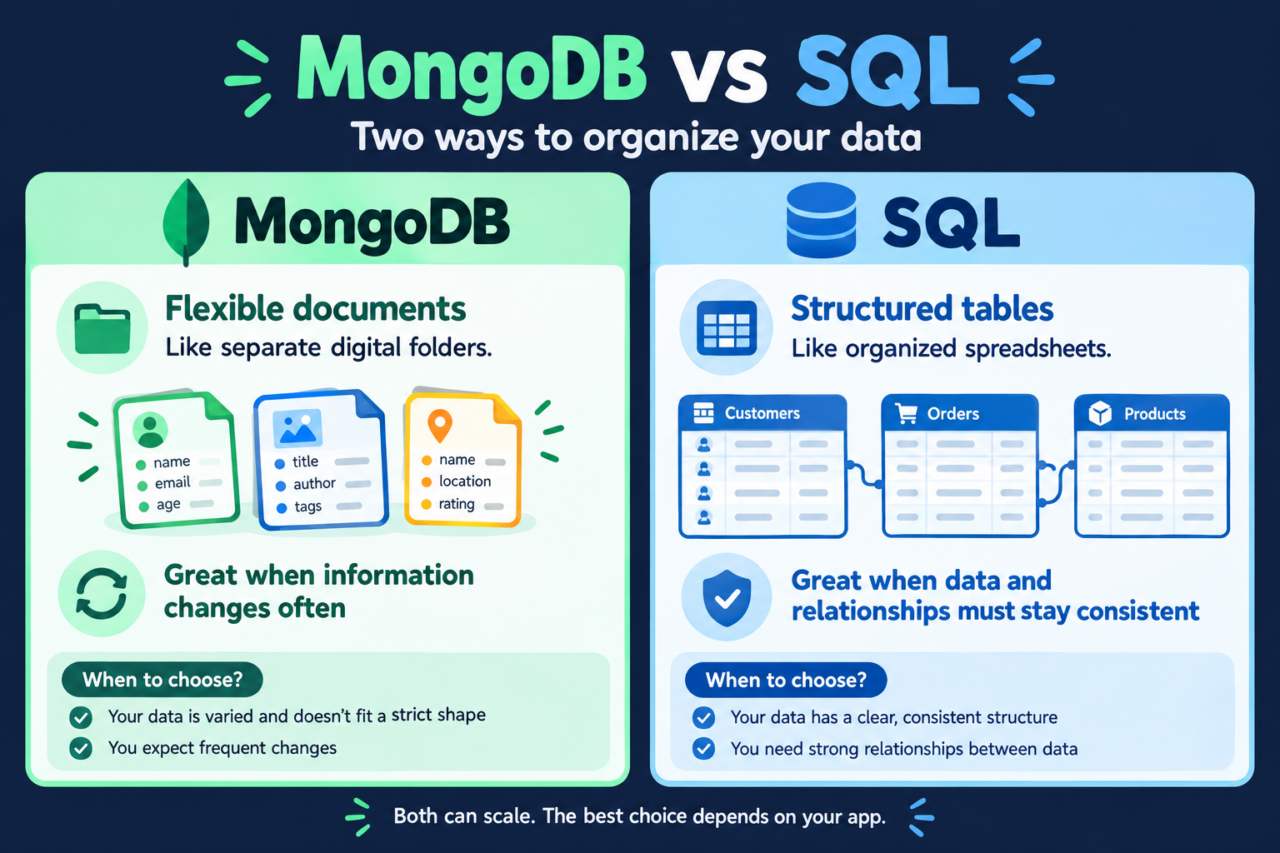
When you build a website, mobile app, or business application, you need somewhere to store all the information your application uses. That is where databases come in.
Two popular approaches are MongoDB and SQL databases. Both can store, search, update, and manage data, but they organize that data in very different ways.
The easiest way to think about it is:
MongoDB is like a collection of flexible digital documents. SQL is like a collection of organized spreadsheets.
Let’s break down the differences.
1. Data Model: Documents vs. Tables
MongoDB: Document-based
MongoDB stores information in documents. These documents look similar to JSON and can contain different types of information together.
For example, a product might look like this:
{
  name: "Laptop",
  price: 50000,
  category: "Electronics"
}
Another product could contain completely different information without necessarily requiring the entire database structure to change.
This makes MongoDB particularly useful when your data is flexible or changes frequently.
SQL: Relational and table-based
SQL databases store information in tables, made up of rows and columns.
A products table could look like this:
| ID | Name | Price | Category |
|---|---|---|---|
| 1 | Laptop | 50000 | Electronics |
| 2 | Headphones | 5000 | Electronics |
Every row follows the structure defined for the table.
This approach works especially well when your information is well organized and predictable.
2. Data Format
Another way to understand the difference is to look at how the data itself is represented.
MongoDB uses a document-oriented format, based on JSON-like data. This allows related information to be stored together in one document.
SQL uses rows and columns, with each column having a defined data type.
Think of it this way:
MongoDB: “Here is everything about this item.”
SQL: “Here is one row in a carefully organized table.”
Neither approach is inherently better. They are designed for different kinds of problems.
3. Schema: Flexible vs. Fixed
The schema is essentially the blueprint for your data.
MongoDB is known for its flexible schema. Documents in the same collection can have different fields.
For example:
Product A
name
price
category

Product B
name
price
category
color
brand
This can be convenient when the information you store changes over time.
SQL generally uses a more structured schema. A table defines its columns, their types, and often rules about what values are allowed.
That structure can be extremely useful when consistency matters.
A simple analogy:
MongoDB is like a flexible form where you can add new questions. SQL is like a standardized form where everyone fills in the same boxes.
4. Query Language
Both databases allow you to ask questions about your data, but they use different approaches.
MongoDB uses its own query syntax. For example:
db.products.find({
  category: "Electronics"
})
SQL uses the SQL language:
SELECT *
FROM products
WHERE category = 'Electronics';
Both queries essentially ask the same thing:
“Show me the products in the Electronics category.”
The syntax is different, but the goal is the same: find the information you need.
5. Relationships Between Data
This is one of the biggest differences.
SQL databases are particularly well suited to data with many relationships.
Imagine an online store. You might have:
- Customers
- Orders
- Products
- Payments
An SQL database can connect these tables using relationships and foreign keys, and then use joins to retrieve related information.
MongoDB can handle relationships too, but developers often choose between embedding related information inside a document or storing references to other documents.
MongoDB can therefore be very convenient when related information naturally belongs together.
6. Scalability
As an application becomes popular, its database may need to handle millions or even billions of records and a large number of users.
MongoDB was designed with horizontal scaling in mind. This means data can be distributed across multiple servers.
SQL databases have traditionally relied heavily on vertical scaling, meaning you give the server more powerful hardware. Modern SQL systems, however, can also support horizontal and distributed architectures.
So the old idea that “MongoDB scales and SQL doesn’t” is misleading.
Both can scale. The best solution depends on the application, workload, and database architecture.
7. Best Use Cases
So when does each option make sense?
MongoDB is a strong choice for:
Applications where data can have different shapes, such as content platforms, product catalogs, real-time applications, and systems where requirements change frequently.
MongoDB can be especially convenient when developers want to move quickly without constantly redesigning a rigid database structure.
SQL is a strong choice for:
Applications with highly structured information and important relationships between data.
Examples include:
Banking systems, accounting software, ERP systems, inventory systems, and many enterprise applications.
When accuracy, consistency, relationships, and reliable transactions are critical, a relational database is often an excellent choice.
8. Popular Examples
MongoDB is one of the best-known document databases. Other examples include Amazon DocumentDB and CouchDB.
In the SQL world, popular databases include:
MySQL, PostgreSQL, Microsoft SQL Server, Oracle Database, and SQLite.
It’s worth noting that “SQL” refers to the relational database approach and the SQL language, rather than one specific database product.
MongoDB vs. SQL: The Simple Answer
The choice becomes much easier when you stop thinking about which database is “better” and instead ask:
What kind of data does my application have?
Choose MongoDB when you want flexible, document-style data and your application’s information may change or vary.
Choose SQL when your data has a clear structure, strong relationships, and consistency is especially important.
And in the real world, applications don’t always have to choose just one. Different databases can be used for different parts of the same system.
Final Takeaway
MongoDB and SQL are two different ways of solving the same fundamental problem: how to store and work with data.
MongoDB gives you flexibility.
SQL gives you structure and powerful relationships.
So rather than asking:
“Which one is the best?”
A better question is:
“Which one fits the way my application needs to store and use information?”
That is the real difference between MongoDB and SQL.
 Banko Stoyanov